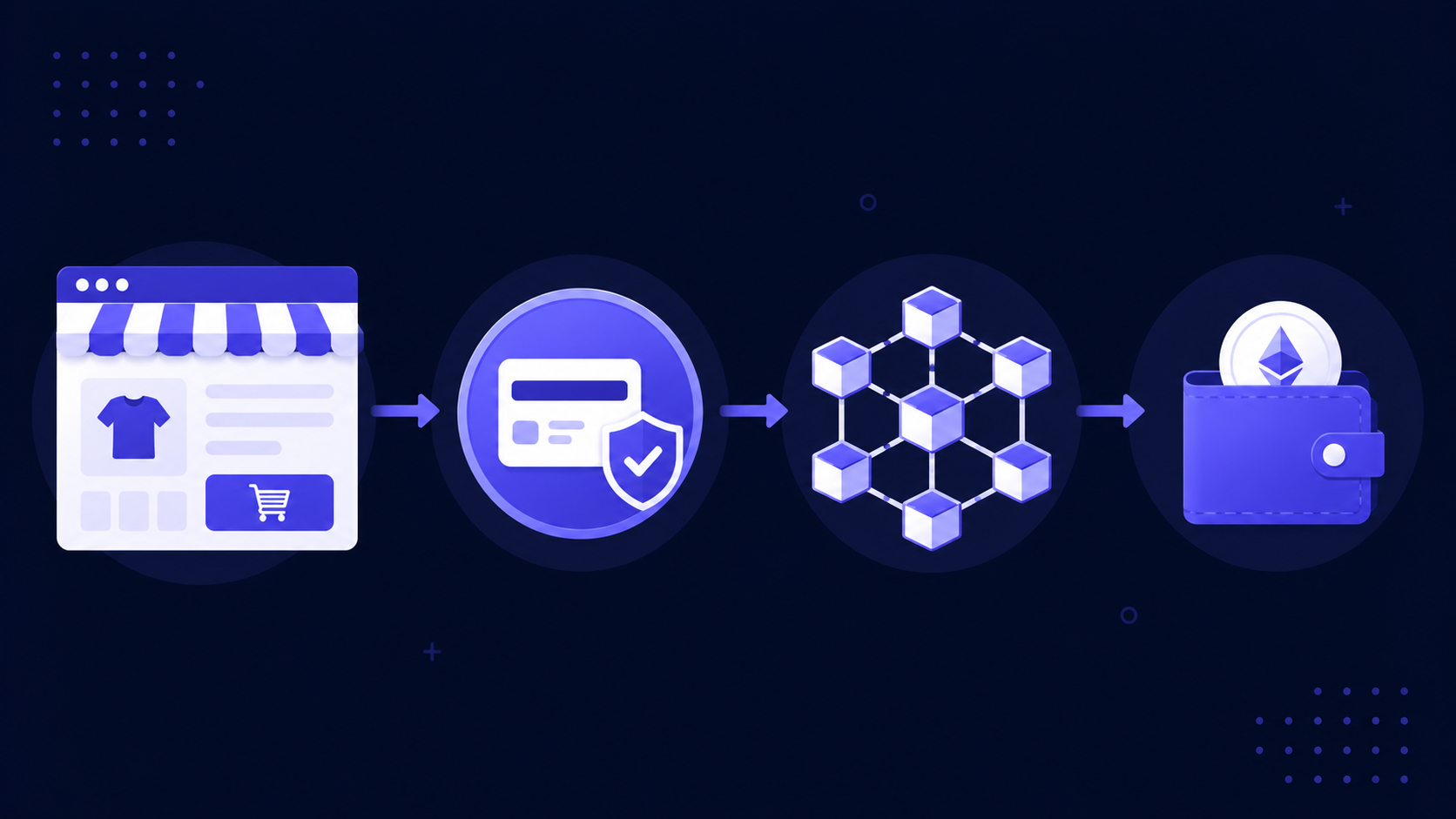
The Problem They Solve
You cannot give every customer the same Bitcoin address. If 100 customers send BTC to the same address, you have no way to know which payment belongs to which order. A crypto payment gateway solves this by generating a unique deposit address for every transaction.
Step-by-Step: What Happens at Checkout
- Customer selects crypto at checkout. Your store sends an API request to the gateway with the order amount and currency (e.g., $49.99 USD).
- Gateway calculates the crypto equivalent. Using a live exchange rate, it converts $49.99 into the equivalent BTC or USDT amount and locks that rate for the session (typically 30 minutes).
- A unique address is generated. The gateway creates a fresh deposit address derived from your wallet. Every order gets its own address so payments can be tracked individually.
- Customer sends funds. The customer scans the QR code or copies the address and sends the exact amount from their wallet.
- Gateway monitors the blockchain. The gateway watches the network for incoming transactions to that address. Once a transaction is broadcast, the gateway detects it within seconds.
- Confirmation and webhook. After the required number of block confirmations (1 for most coins), the gateway marks the payment as complete and sends a webhook to your server.
- Funds arrive in your wallet. Because the deposit address belongs to your wallet, the funds are already under your control. No withdrawal request, no waiting period.
Custodial vs Non-Custodial Gateways
Some gateways hold your funds and let you withdraw later (custodial). Others, like CryptoGate, generate addresses from your own wallet keys so funds go directly to you (non-custodial). The non-custodial model eliminates counterparty risk — there is no company that can freeze or lose your money.
What Happens if the Customer Sends the Wrong Amount?
This is called an underpayment. Most gateways handle it in one of two ways: mark the payment as partial and notify you to handle it manually, or automatically request the customer top up the difference. Overpayments are typically credited in full and flagged for review.
What Happens if the Customer Sends Too Late?
If the 30-minute window expires before the funds arrive, the session is marked as expired. If funds arrive after expiry, they are detected and the gateway notifies you — most platforms let you manually accept or refund late payments.
Summary
A crypto payment gateway handles address generation, rate locking, blockchain monitoring, and order confirmation automatically. You integrate it once, and it handles the complexity of crypto transactions while sending funds directly to your wallet.