Overview
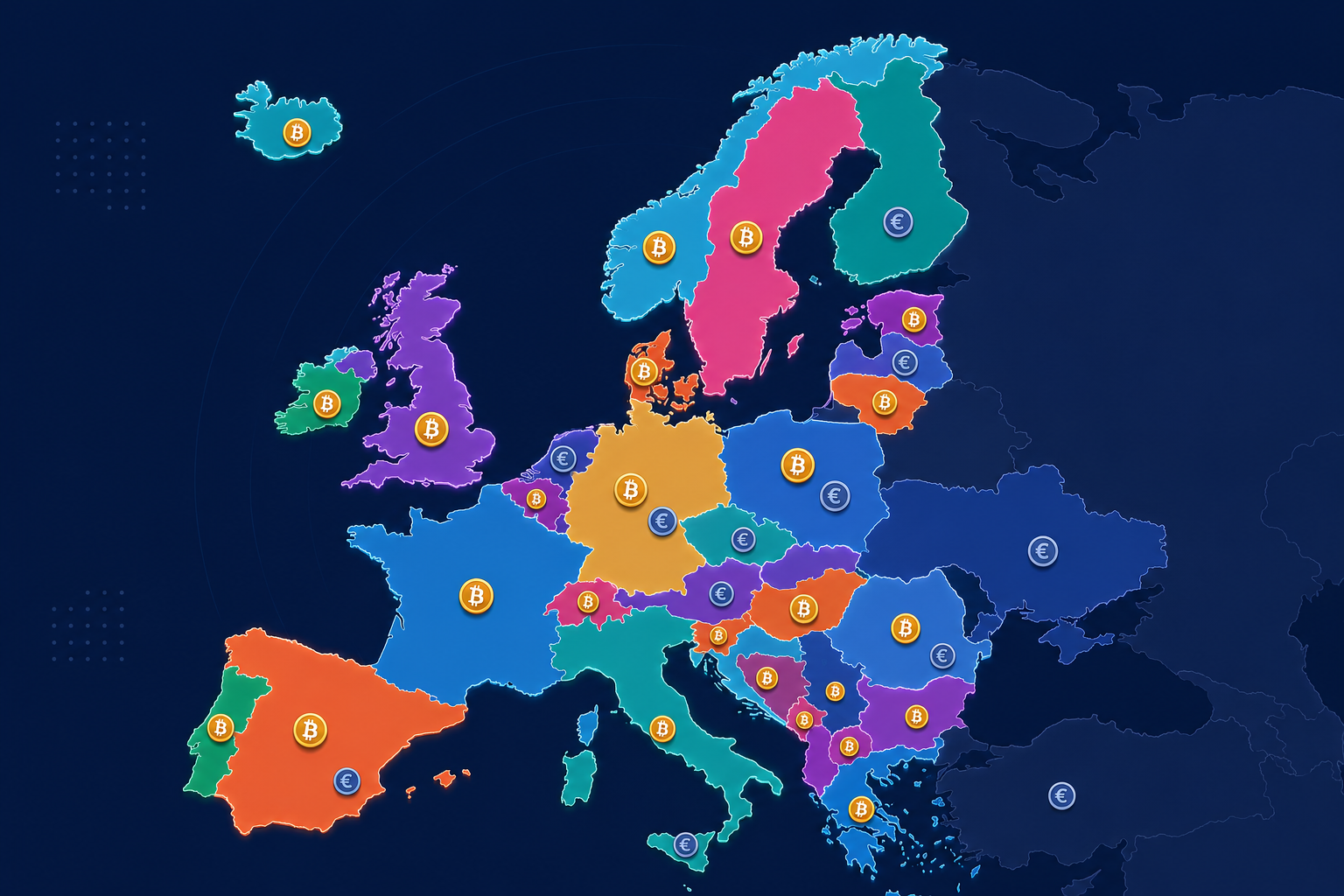
Europe has some of the most diverse crypto tax policies in the world. Investors in neighbouring countries can face wildly different obligations based solely on their country of residence. This article compares six major European jurisdictions: Germany, France, Spain, Poland, Portugal, and Switzerland.
| Country | Capital Gains Rate | Long-Term Exemption | Tax-Free Threshold | Crypto-to-Crypto Taxable? |
|---|---|---|---|---|
| Germany | Income rate (up to 45%) | Yes — free after 12 months | €600 per year | Yes (resets holding period) |
| France | 30% flat (PFU) | No | €305 per year | No — only fiat disposals |
| Spain | 19–28% progressive | No | None | Yes |
| Poland | 19% flat | No | None | Yes |
| Portugal | 28% (held under 1 year) | Yes — free after 365 days | None | No — only fiat disposals |
| Switzerland | 0% (private investors) | N/A | N/A | No |
Germany
Germany offers one of the most investor-friendly rules in the EU: cryptocurrency held for more than 12 months is completely tax-free for private individuals, regardless of the profit. This makes Germany attractive for long-term holders.
For short-term disposals (held under 12 months), gains are taxed as personal income at marginal rates up to 45%. However, there is a €600 annual exemption — gains below this threshold are not taxed.
Key caveats: staking or lending crypto may restart the 12-month holding clock in some interpretations. Crypto-to-crypto swaps are taxable events and reset the holding period. Germany''s tax authority (Bundeszentralamt für Steuern) has issued detailed guidance on most common scenarios.
France
France applies a flat 30% tax rate (prélèvement forfaitaire unique, or PFU) on net capital gains from crypto disposals. This includes a 12.8% income tax and 17.2% social contributions.
A notable French rule: crypto-to-crypto swaps are not taxable. Only conversions to fiat or use of crypto to purchase goods trigger a taxable event. This gives French investors significant flexibility to rebalance portfolios without immediate tax consequences.
There is a small annual exemption of €305 in total portfolio gains below which no tax is owed. Losses can offset gains within the same year but cannot be carried forward.
Spain
Spain taxes crypto capital gains using a progressive scale: 19% on the first €6,000 of gains, 21% on the next €44,000, 23% up to €200,000, and 28% above that. This means large gains face a significant tax burden.
Crypto-to-crypto swaps are taxable events in Spain. Losses can offset gains and be carried forward for four years. Spanish residents must also report holdings abroad above €50,000 via the Modelo 720 form, which applies to crypto held on foreign exchanges.
Spain''s tax authority (Agencia Tributaria) has been aggressive in enforcing crypto compliance, sending warning letters to tens of thousands of crypto holders in recent years.
Poland
Poland applies a flat 19% capital gains tax on all crypto disposals, regardless of the holding period. There is no long-term exemption and no minimum threshold — every profitable transaction is theoretically taxable.
Crypto-to-crypto swaps are taxable events. Losses can offset gains and be carried forward for five years, but only against capital gains income (not ordinary income). Polish residents report on the PIT-38 form by April 30 each year.
For a detailed guide to Polish crypto tax rules, see our dedicated articles: Polish Crypto Tax Laws: A Complete Guide and How to Declare Cryptocurrency in Poland (PIT-38).
Portugal
Portugal was long considered a crypto tax haven, with no capital gains tax on cryptocurrency for private investors. That changed in 2023: gains from crypto held for less than 365 days are now subject to a 28% tax rate.
However, the long-term exemption remains: cryptocurrency held for more than one year is still completely tax-free for private investors. This mirrors Germany''s approach. Crypto-to-crypto swaps are not taxable in Portugal — only conversions to fiat are.
Portugal also taxes mining income and staking rewards as business income or professional income, depending on the circumstances.
Switzerland
Switzerland is the most favourable jurisdiction for crypto investors in Europe. Private individuals pay no capital gains tax on cryptocurrency profits. Switzerland does not treat crypto as a financial instrument subject to capital gains rules.
However, Switzerland does levy a wealth tax on crypto holdings at cantonal rates (typically 0.1–1% of portfolio value annually). And mining income, professional trading, and business-related crypto activity can be taxed as income.
The definition of "professional trader" versus "private investor" is determined by Swiss tax authorities on a case-by-case basis. Frequent trading, leverage, and trading as a primary income source all suggest professional status.
Key Takeaways for EU Residents
- If you are a long-term holder, Germany and Portugal offer meaningful tax advantages through holding-period exemptions.
- If you want to rebalance your portfolio without triggering tax, France and Portugal stand out because crypto-to-crypto swaps are not taxable events.
- Switzerland is the only major European country with no capital gains tax on crypto for private investors, but it comes with a wealth tax.
- Poland and Spain offer no holding-period advantage — all gains are taxable at the point of disposal.
- Tax residency is determined by where you live, not where you trade — changing country of residence can have significant crypto tax implications.
Tax laws change frequently. Always verify current rules with your national tax authority or a qualified tax advisor before making decisions based on this comparison.