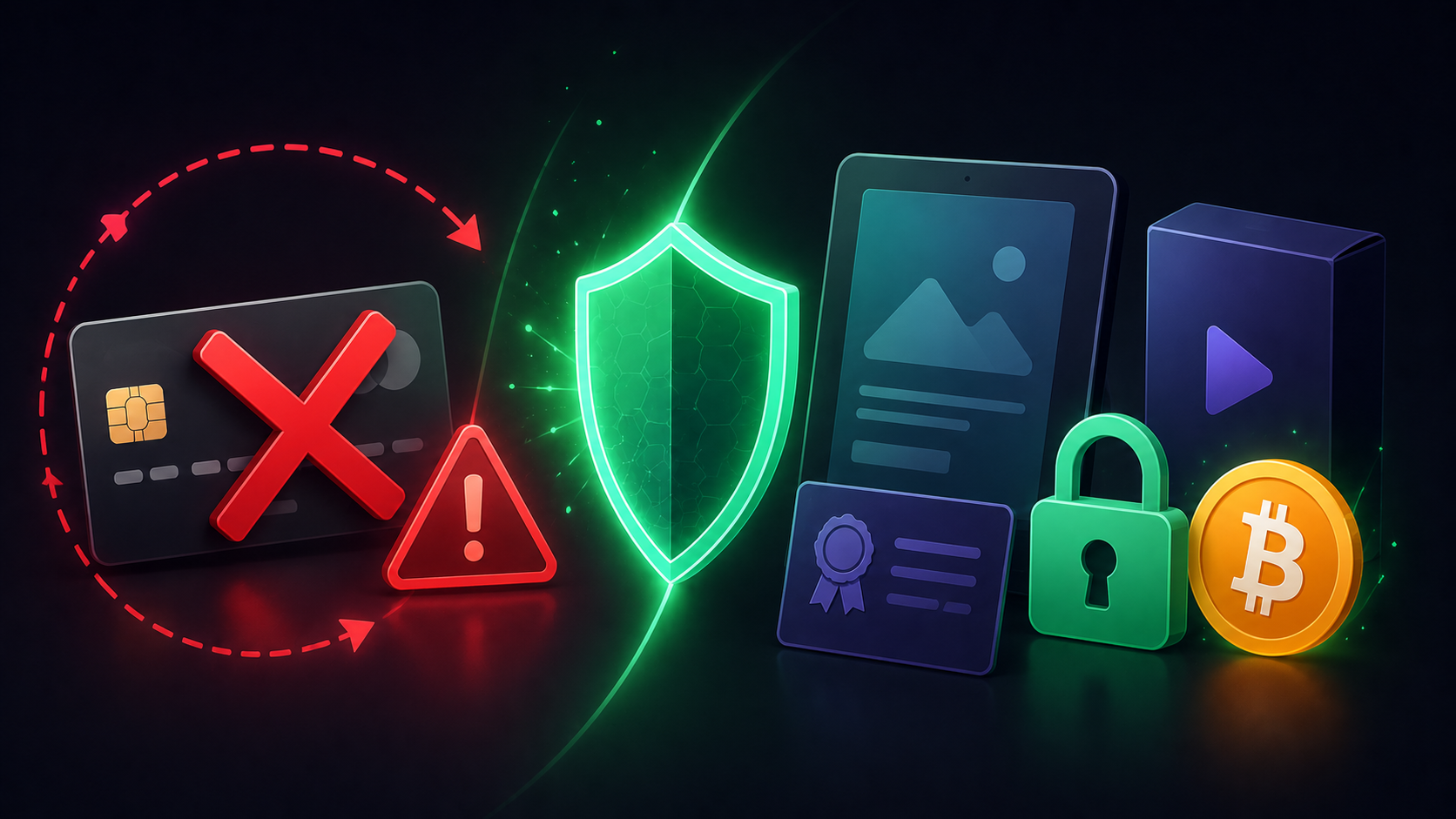
The Digital Product Chargeback Problem
If you sell ebooks, online courses, templates, stock photos, plugins, or any downloadable product, you are at risk of "friendly fraud" — where a customer downloads your product and then disputes the charge with their bank.
The economics are brutal:
- Average chargeback fee: $20–100 per dispute (paid whether you win or lose)
- You typically lose the product sale as well as the fee
- Winning a chargeback dispute is difficult because banks default to favouring the cardholder
- If your chargeback ratio exceeds 1%, payment processors suspend your account
Digital goods have the highest chargeback rates of any e-commerce category — precisely because there is no physical goods return to complicate the dispute. A buyer can claim non-delivery even after downloading, and you have limited recourse.
Why Crypto Eliminates This Entirely
Cryptocurrency transactions are cryptographically irreversible. Once a transaction is confirmed on-chain, no bank, payment processor, or intermediary can reverse it. The customer's only recourse is to contact you directly for a refund — which you control completely.
There is no dispute system, no bank arbitration, no chargeback fee. The customer paid. The payment is final.
Digital Products That Benefit Most from Crypto Payments
- Ebooks and PDF guides — immediate download, highest chargeback risk
- Online courses and video content — access granted instantly, often disputed after completion
- Software licences and plugins — WordPress plugins, browser extensions, SaaS tools
- Templates and design assets — Figma, Notion, Canva templates
- Music, audio, and video files — beats, samples, stock footage
- Fonts and graphics — commercial licences, icon packs
- Written content — newsletter subscriptions, research reports
Setting Up Crypto Checkout for Digital Products
Step 1: Create Your CryptoGate Account
Sign up at cryptogate.live (free, no KYC). Connect your wallet using your xPub key. Enable the cryptocurrencies you want to accept.
Step 2: Integrate at Checkout
When a customer selects "Pay with Crypto," create a transaction via the API:
POST https://api.cryptogate.live/v1/transactions
{
  "amount": "29.00",
  "currency": "USD",
  "crypto": "BTC",
  "metadata": {
    "product_id": "ebook-seo-guide",
    "customer_email": "buyer@example.com"
  }
}
Redirect the customer to the returned payment_url. The hosted payment page handles displaying the address, QR code, countdown timer, and payment status — no frontend work required.
Step 3: Grant Access on Payment Completion
Set up a webhook endpoint to receive payment events. When payment.completed fires, trigger your product delivery:
// On payment.completed webhook
if (event.type === 'payment.completed') {
  const { product_id, customer_email } = event.transaction.metadata;
  await sendDownloadLink(customer_email, product_id);
  // Or: unlock access in your course platform
  await grantCourseAccess(customer_email, product_id);
}
Step 4: Store the Transaction Record
Always save the CryptoGate transaction ID alongside the order record. This is your proof of payment — a blockchain transaction ID that is publicly verifiable on any block explorer. Unlike card payments, crypto transactions cannot be denied.
Platform Integration Options
How you integrate depends on your existing platform:
- Custom site: Direct API integration as shown above. Full control.
- Gumroad / Lemon Squeezy / Payhip: These platforms do not currently support CryptoGate natively. Use a redirect flow: collect the customer's email, generate a CryptoGate payment link, redirect them, and send the download link via webhook when payment confirms.
- WooCommerce: See our WooCommerce crypto setup guide for plugin-based integration.
- Shopify: See our Shopify crypto payments guide.
Should You Offer Crypto-Only or Alongside Cards?
For most digital product businesses, the answer is: alongside cards. You will capture more total sales by offering both options. Consider positioning crypto as a feature — "Pay with Bitcoin for privacy" or "Pay with crypto and save 5%" — rather than requiring it.
Over time, you can measure what percentage of your sales convert on the crypto channel and adjust incentives accordingly.
Handling Refunds in Crypto
Crypto refunds must be initiated manually by you — you send a separate transaction to the customer's wallet. Unlike chargebacks, this is completely within your control:
- You decide whether to refund
- You decide the refund amount (full or partial)
- You choose when to issue it
- There are no third-party fees or penalties
A reasonable refund policy for digital products: refund within 7 days if the customer has not yet accessed/downloaded the product. Once accessed, all sales are final. This is standard in the industry and not contestable via crypto since there is no bank dispute system.
The Bottom Line for Digital Product Creators
If chargebacks are eating your margins or threatening your payment processor relationship, crypto is the cleanest solution available. Set up CryptoGate, add a "Pay with Bitcoin" option to your checkout, and eliminate the entire chargeback category for every customer who chooses it.